
Manuka Honey vs Regular Honey: All the Differences
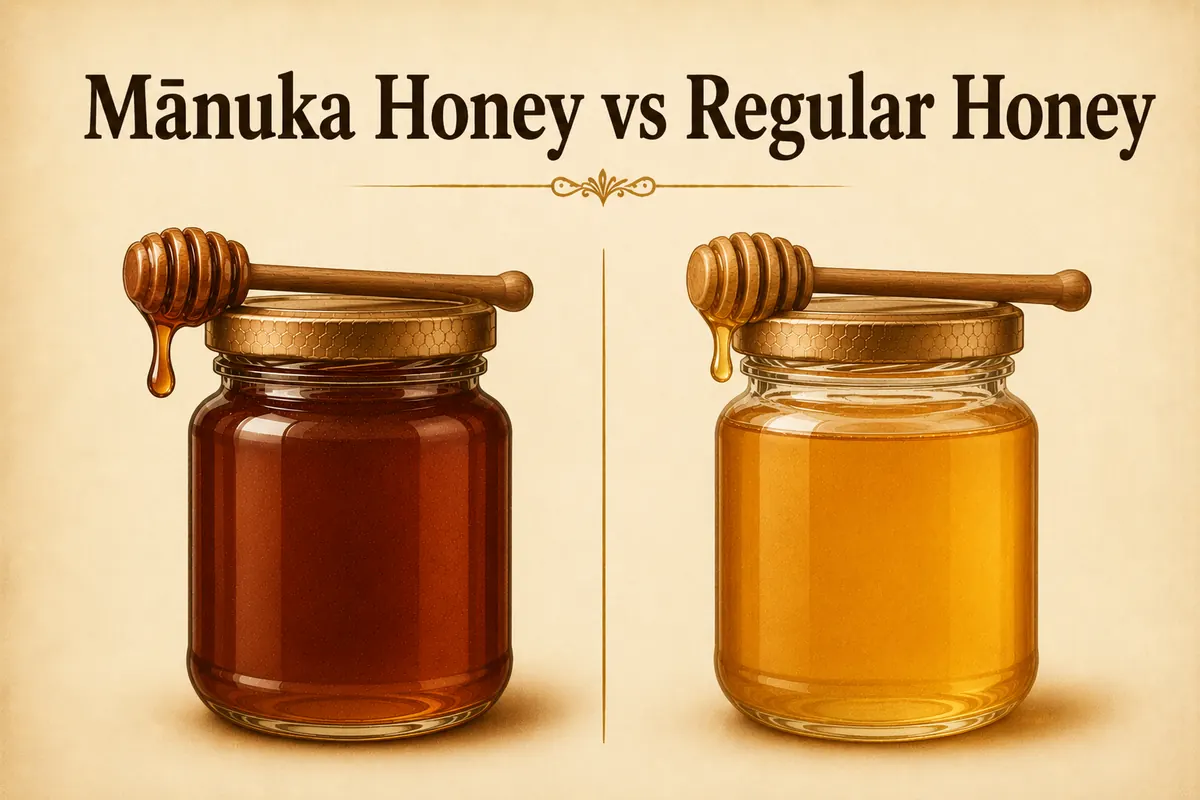
Manuka honey and regular honey are both honey: bee-produced, sugar-rich, naturally antibacterial. But they differ in mechanism, price, regulation, and use case. The differences are real but specific. This article covers what changes when you move from a $5 jar of clover honey to a $90 jar of UMF 20+ Manuka.
What is the main difference between Manuka honey and regular honey?
The main difference is the antibacterial mechanism. Regular honey's antibacterial action depends on hydrogen peroxide, which degrades in light, heat, and stomach acid. Manuka honey has a second mechanism, driven by methylglyoxal (MGO), that is heat-stable and survives those conditions. This is called Non-Peroxide Activity (NPA).
Side-by-side comparison
| Attribute | Regular honey | Manuka honey (UMF-certified) |
|---|---|---|
| Source plant | Various (clover, wildflower, etc.) | Leptospermum scoparium (Manuka tree) |
| Origin | Worldwide | New Zealand and Australia |
| Antibacterial mechanism | Hydrogen peroxide (degradable) | MGO + leptosperin (heat-stable) |
| Antibacterial activity vs heat / acid | Lost | Preserved |
| MGO content | Trace amounts | 83 - 1200+ mg/kg |
| Authentication | None standard | UMFHA + MPI Manuka Honey Definition |
| Typical retail price (250 g) | $5 - $15 | $30 - $200+ |
| Use case | Sweetener; light wellness | Sweetener + antibacterial applications |
| Glycemic index | ~55-60 | ~50-55 |
| Shelf life | Indefinite | Indefinite |
Is regular honey antibacterial?
Yes, in laboratory tests. Regular honey produces hydrogen peroxide via the enzyme glucose oxidase (added by bees). The activity is potent in vitro but unstable. By the time the honey is consumed or applied to skin in real-world conditions, much of the activity is lost.
Is Manuka honey worth the premium over regular honey?
For daily sweetening, no. Regular honey at a fraction of the price provides equivalent caloric and flavour value. For specific use cases that depend on antibacterial activity (wound care, oral health, certain skin applications), the premium is justified by the laboratory-verified active compound content. For most consumers, the answer is "use both": regular honey for cooking and tea, Manuka for the specific applications where the antibacterial activity matters.
Does Manuka taste different from regular honey?
Yes. Manuka is darker, denser, and earthier than typical clover honey. Higher-MGO Manuka has a stronger medicinal-bitter back-note. Lower-MGO Manuka and multifloral Manuka are milder. The texture is generally thicker than clover honey.
Is Manuka honey healthier than regular honey?
"Healthier" depends on what you measure. Per gram, Manuka and regular honey have similar caloric content, similar carbohydrate profiles, and similar effect on blood sugar. Manuka has measurably higher antibacterial activity in laboratory tests. Whether that translates to improved health outcomes depends entirely on use case.
Common questions
Can I substitute Manuka for regular honey in recipes?
Yes. The substitution is 1:1 by volume. Note that high heat (above ~100°C) gradually degrades MGO, so for baked goods you are paying for a property that is partly cooked off.
Is local raw honey better than Manuka for allergies?
For pollen-exposure-based allergy desensitization, local raw honey is more research-aligned. Manuka is not the variety the allergy-trial research used. See our allergies review.
Should I buy regular honey or Manuka for my daily teaspoon?
For sweetening alone, regular honey. For UMF-verified antibacterial activity, Manuka. For most consumers, both. See our daily-use roundup for the value tier.
For the full breakdown of how Manuka achieves its antibacterial activity, see our NPA explainer.