
Manuka Honey UMF vs MGO: How the Two Grading Systems Compare
UMF and MGO are the two main grading systems for Manuka honey, and they aren't equivalent. UMF certifies four markers (leptosperin, DHA, methylglyoxal, and HMF) through an accredited laboratory and licenses the result. MGO measures methylglyoxal alone and isn't regulated; the brand prints the number. The chemistry overlaps. The verification doesn't.
This post compares the two side by side: what each measures, how their numbers convert, which brands use which, and which one to trust when you spend money on a jar.
What is UMF?
UMF (Unique Manuka Factor) is a four-marker certification administered by the UMF Honey Association in New Zealand. Every UMF-licensed batch is tested by an independent laboratory for leptosperin, dihydroxyacetone (DHA), methylglyoxal, and hydroxymethylfurfural (HMF), then assigned a numeric grade printed on the jar.
The four markers aren't decorative. Leptosperin is the Manuka authenticity marker (other floral sources don't carry it). DHA is the precursor that slowly converts into methylglyoxal over time, so it signals shelf life and freshness. Methylglyoxal is the active compound responsible for the honey's antibacterial behaviour. HMF rises when honey has been heated or aged badly. A UMF grade summarises all four into one number.
UMFHA was established in 1998. The licensing process isn't cheap. Brands pay an annual fee plus per-batch testing costs, which is why you'll see plenty of authentic Manuka brands without UMF on the label. The licence is a quality bar; it isn't the only honest signal.
What is MGO?
MGO is a single-marker rating that reports the milligrams of methylglyoxal per kilogram of honey. It's a chemistry number, not a certification. A jar showing MGO 829+ contains at least 829 mg of methylglyoxal per kg, measured at the time of test. Independent verification is not required.
Methylglyoxal was identified as the compound driving Manuka's non-peroxide activity in 2008 by Professor Thomas Henle's team at the Technical University of Dresden. The published paper measured MGO levels orders of magnitude higher in Manuka than in any other honey type. Brands picked up the MGO rating almost immediately because it gave them a simple, headline-friendly number to print.
The catch: MGO is self-reported. The brand can run the test in-house or commission a lab. Reputable producers commission independent tests. Less reputable ones don't. You can't tell from the label which is which.
How do UMF and MGO differ?
UMF tests four markers including methylglyoxal, plus three authenticity and quality checks. MGO measures methylglyoxal alone. UMF is licensed by UMFHA and verified by an accredited laboratory. MGO is a number any brand can print without third-party oversight. UMF guarantees a minimum at test; MGO carries no such guarantee.
What does UMF measure that MGO does not?
Three things, all of them load-bearing.
Leptosperin tells you the honey came from Leptospermum scoparium nectar and not some other floral source. Without leptosperin, the jar isn't legitimately Manuka, no matter how high the MGO. DHA tells you the honey has the precursor that will continue converting into methylglyoxal during storage. HMF tells you the honey hasn't been overheated or aged out. MGO on its own tells you nothing about any of this.
Does UMF guarantee a minimum grade?
Yes. A UMF 20+ jar is guaranteed to test at UMF 20 or higher at the time of certification. The certificate, which comes with every batch, publishes the actual measured values for all four markers. MGO labels carry no such guarantee from the licensing body. The brand's internal quality control is the only thing standing between the printed number and reality.
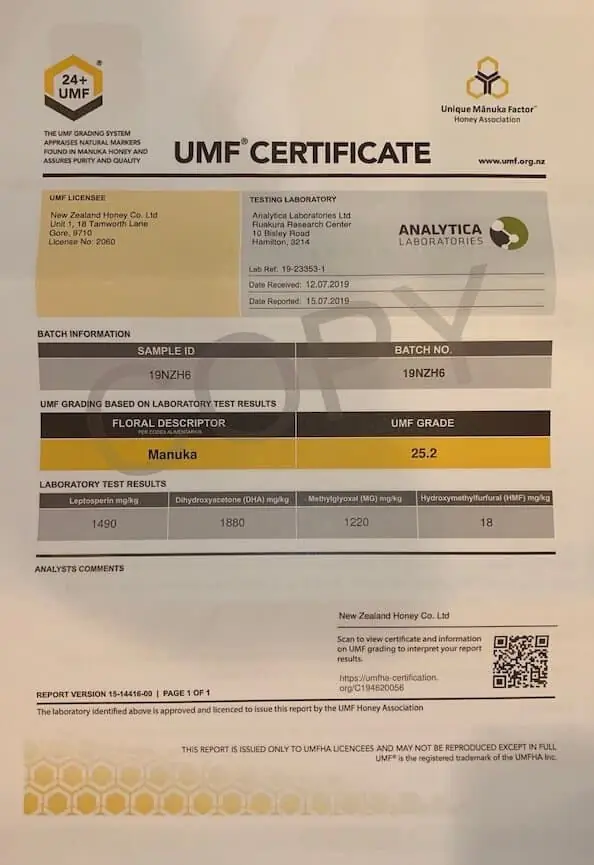
A real UMF certificate. The four marker values (leptosperin, DHA, methylglyoxal, HMF) are published per batch.
Is one more reliable than the other?
UMF is the safer signal for buyers who don't already trust the brand. The independent lab step plus the four-marker check is the part that's hard to fake. MGO-only is fine when the brand has built a track record of accurate self-reporting (Manuka Health is the most prominent example), but you're trusting the brand's chemistry, not a regulator's.
How do UMF and MGO numbers convert?
UMF and MGO measure related quantities, so they correlate predictably. UMFHA publishes approximate equivalencies: UMF 5+ ≈ MGO 83+, UMF 10+ ≈ MGO 263+, UMF 15+ ≈ MGO 514+, UMF 20+ ≈ MGO 829+, UMF 24+ ≈ MGO 1122+. The conversion is approximate, not exact.
The UMF to MGO conversion table
These are the published equivalencies, taken from UMFHA's own grading documentation:
UMF rating Approximate MGO (mg/kg) Tier Typical use case UMF 5+83+MildDaily sweetening, tea, yoghurt UMF 10+263+ModerateMost commonly stocked band UMF 15+514+HighHigh band, steep price climb UMF 20+829+PremiumResearch-aligned high-MGO use UMF 24+1122+Ultra-premiumHighest commercially available
Need to convert a number that isn't on this table? Use our MGO-UMF converter which runs the regression in both directions.
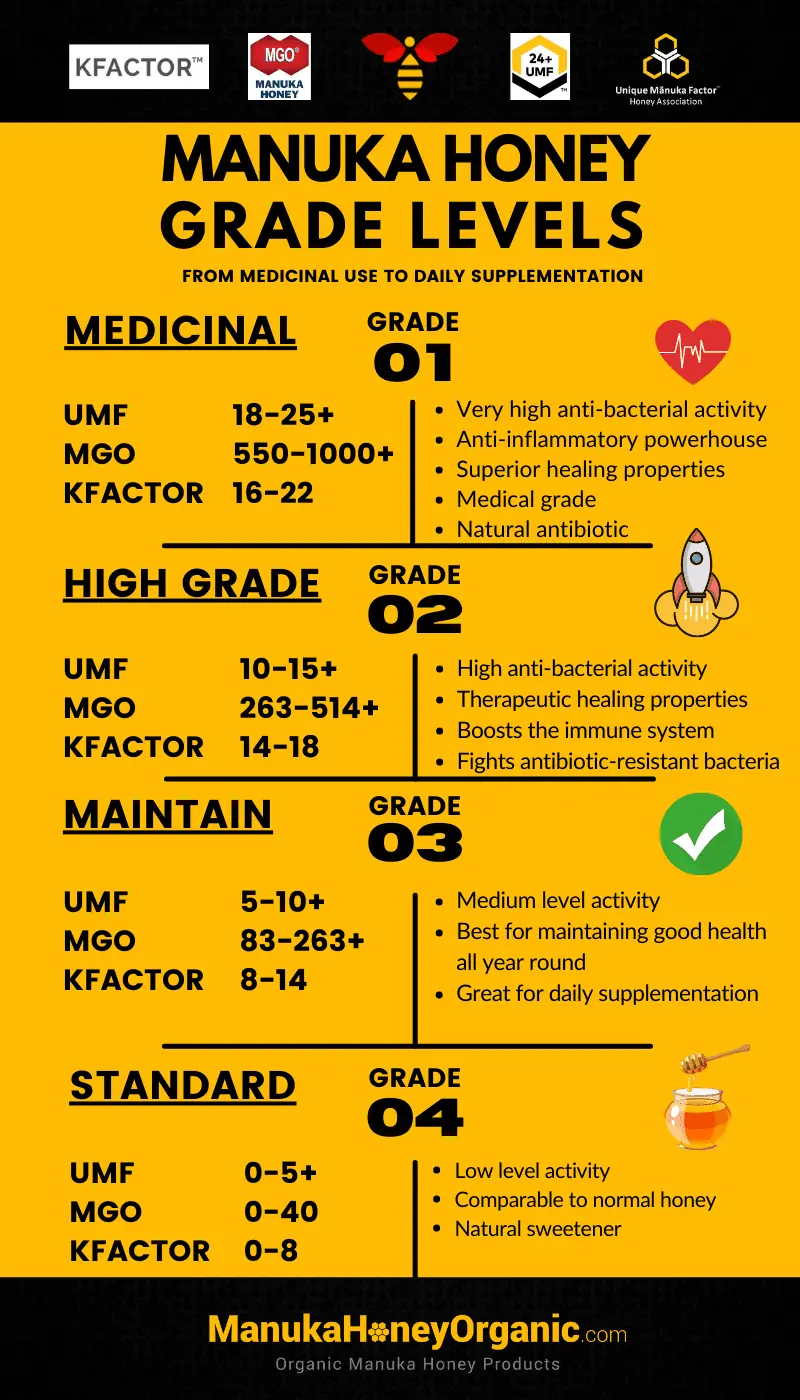
UMF and MGO ranges across four tiers. The two systems describe the same chemistry from different angles.
Why the conversion is approximate, not exact
UMF tests four compounds. MGO tests one. The conversion formula is a regression UMFHA derived from thousands of paired tests, but each individual jar has its own ratio of DHA to MGO, its own HMF, its own leptosperin signature. Two jars at UMF 20+ might land at MGO 820 and MGO 870 respectively. The published numbers are floors, not exact midpoints.
Which brands use UMF and which use MGO?
The split runs along licensing strategy, not honey quality. Both camps include legitimate, well-regarded producers. You can read the per-brand breakdown in our independent brand reviews.
UMF-certified brands
Comvita is the most prominent UMF licensee and the one most consumers in export markets recognise. Manukora, Happy Valley, Kiva, and New Zealand Honey Co all carry UMF licensing across most or all of their range. The list of currently UMFHA-licensed brands updates regularly on the UMFHA site.
MGO-only brands
Manuka Health built its brand on the MGO rating and remains the largest MGO-only producer. Manuka Doctor uses MGO on most of its US-market lines. Both run internal lab programmes that hold up reasonably well when we cross-check batches, but the verification stack isn't as deep as the UMF chain.
Why some brands choose one over the other
UMF licensing costs real money and takes time. Smaller producers and newer entrants often start with MGO labelling because it's the lower-friction path: run the methylglyoxal test, print the number, ship the jar. Larger producers committed to the export market eventually move toward UMF because retail buyers in the UK, US, and EU recognise it as the gold-standard certification.
One thing worth flagging: a few large brands use neither. Wedderspoon, for example, runs its own KFactor system, which measures different things and doesn't map cleanly onto either UMF or MGO. We cover KFactor and the other less-common ratings in the broader ratings guide.
Which grading system should you buy?
Buy UMF when authenticity matters most. The four-marker test rejects fake Manuka and certifies activity in one go. Buy MGO-only when you trust the brand's internal programme and want a specific potency at a lower price point. Both grading systems describe real chemistry. UMF adds independent verification; MGO does not.
When UMF is the safer choice
Three situations make UMF the right call. If it's your first jar of Manuka, the UMF licence pays for itself by ruling out misbranded honey. If you're buying as a gift, the certificate is something the recipient can verify. If you're using the honey for a specific therapeutic application (wound care, daily immune support, recovery from illness), the activity guarantee gives you a floor to plan around.
When MGO-only is fine
If you've used the brand for years and the chemistry has held up, the MGO route saves you the UMF premium. If you've already tested the jar yourself, or trust an independent reviewer who has, the label number is a useful shorthand. Each UMF-licensed batch is independently lab-tested before the grade is printed on the jar.
How to spot misleading labels
A few red flags worth memorising. "Active 20+" is not the same as UMF 20+. "Active" is a meaningless trade term that survives in older inventory. Any jar that prints MGO without a brand name or country of origin should go back on the shelf. Any UMF logo without a licence number underneath is either expired or counterfeit; the number is checkable on the UMFHA site.
What problems do these grading systems solve?
Both systems exist because of the same crisis. In the early 2010s, an estimated four times more Manuka honey was being sold globally than New Zealand actually produced. Counterfeit and adulterated jars were widespread. The grading systems were built to give buyers something to verify.
The pre-2018 authenticity crisis
Before 2018, "Manuka honey" had no legal definition. Anyone could label a jar Manuka and price it accordingly. UMF was the only quality bar that meant anything in retail, and even then enforcement was limited. The honey industry needed a regulatory standard.
How UMF and MGO address fake Manuka
In 2018, New Zealand's Ministry of Primary Industries introduced a monofloral Manuka standard: a four-marker chemical test plus a DNA test for Leptospermum scoparium pollen. Any honey labelled monofloral Manuka for export must clear it. UMF aligns with this standard and adds the activity grade on top. MGO does not, by itself, address authenticity. A high-MGO jar from a non-UMF brand could in theory clear the MPI standard, but the buyer has no certificate to check.
What can you expect from each grade?
Both UMF and MGO describe the same chemistry, so expected behaviour at each tier is similar. The differences are in your right to verification, not in what the honey actually does.
Antibacterial activity by grade
UMF 10+ (MGO 263+) is roughly equivalent in non-peroxide antibacterial activity to a 10% phenol disinfectant solution in laboratory tests. UMF 20+ (MGO 829+) is significantly stronger, used in clinical studies on wound care and sore throat. UMF 24+ (MGO 1122+) is the highest grade routinely available; rarer batches reach MGO 1500+ but are uncommon at retail.
Choosing between the grade bands
No UMF or MGO grade is officially recommended for any condition. The practical differences between bands are price, taste intensity, and methylglyoxal per gram. Higher bands cost steeply more per gram of MGO, so most buyers weigh budget against the label number rather than chasing the top grade.
Common questions
Is higher always better?
Higher grades mean more methylglyoxal per gram, not an officially recommended benefit, and cost per gram climbs steeply above UMF 20+. Match the grade to your budget and taste. We've put real numbers on this in our MGO-UMF converter with a price-per-MGO breakdown.
Can a jar have both UMF and MGO on the label?
Yes, and it's becoming more common. UMF-licensed brands are increasingly printing both numbers because consumers in different markets recognise different systems. The UMF number is the certified one; the MGO number is the chemistry equivalent calculated from the same test.
Which is more expensive, UMF or MGO?
UMF-certified jars run roughly 10-25% higher per gram than MGO-only jars at equivalent grades. The premium reflects the licensing fee, per-batch testing cost, and the more restricted supply (fewer brands carry UMF). Whether that's worth it depends on how much you weight verification.
Does MGO require independent testing?
No. The MGO rating is unregulated. Brands can self-report. Most reputable producers commission third-party tests anyway because their export buyers demand them, but there's no licence body forcing it. The buyer has to trust the brand.
UMF and MGO aren't the only systems on the shelf, just the dominant two. For the wider comparison, including KFactor, BioActive, MGS, and NPA, see the broader ratings guide.